
solution · source-backed review
EVA/PE: Low-Formamide and Low-Odour Evaluation
Evaluate blowing-agent selection, functional additives, processing history and finished-product testing as one system.
Discuss this requirement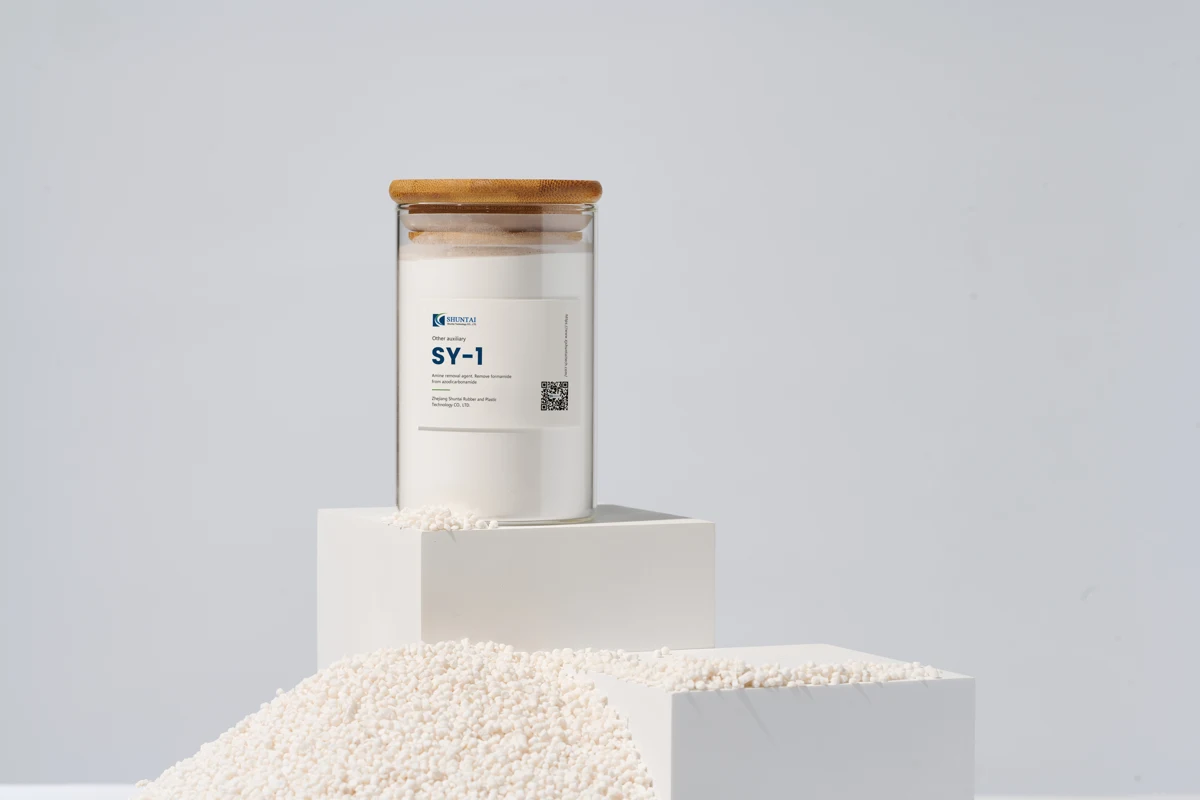
- Approach
- Material and process together
- Validation
- Controlled comparison
- Boundary
- No guaranteed outcome
A foam has more than a density target
The supplied solution covers EVA footwear, yoga and floor mats, children’s foam, PE/EVA sheets and rolls, packaging and cushioning. It treats expansion, cost, formamide, odour, cells, shrinkage and long-term dimensional stability as related targets.
Symptoms that need to be separated
- Elevated formamide test results.
- Odour directly after demoulding or returning after sealed packing.
- Insufficient expansion or increased shrinkage after changing to a lower-temperature agent.
- Coarse, merged or broken cells and unstable skins.
- Density/hardness lost when AC dosage is reduced.
- Batch variation in density, dimensions or odour.
Material, process and acceptance information
Record resin grade, AC model, crosslinking system, actual material temperature, moulding time, thickness and post-ageing. Define the intended market and the specified finished-product tests; odour, VOC and formamide are different evaluation items.
A single substitution may not solve the system
Release before the material develops gas retention can lose gas; late release can leave insufficient foam, residue or later swelling. Match gas release to melting, crosslinking and cooling, instead of treating a lower nominal decomposition temperature as a complete solution.
Three routes from the supplied solution
| Route | Candidate actions |
|---|---|
| Retain the mature AC system | Review SA grade against the temperature window; assess SY-1 and SQ-1/SQ-2 as appropriate; review temperature, time and ageing. |
| Medium/low-temperature modified route | Assess SPE or other modified AC against actual temperature, residence time, crosslinker and activation. |
| AC reduction with an endothermic component | Evaluate NC to adjust release behaviour; determine any additional SY-1/deodoriser need from actual finished-product tests. |
A compound route is not simple addition of ingredients. Components have different decomposition windows, gas types and rates; rebuild the formulation/process window through trials.
Define the effect you intend to measure
Odour reduction does not establish a formamide value, and either result alone does not establish VOC compliance. Select a route from the actual material, processing history and product requirement, not from an unconditional “zero” claim.
Four comparisons and traceable samples
- A · Baseline. Current compound, agent, dose and process, with the current result recorded.
- B · Direct replacement. Change the candidate agent while holding other conditions steady.
- C · Process optimisation. Evaluate permitted adjustments to actual temperature, time, speed, pressure and cooling.
- D · Alternative. Compare a second candidate or a reviewed compound route.
For each group record model, batch, dose, mixing order, equipment settings, actual material temperature, pressure, speed, residence time, mould/die, cooling and sample time.
For this application, also record compound batch, mixing, actual temperature, moulding time, thickness, cooling and ageing before sampling.
Compare more than an initial odour impression
- Apparent density, expansion and part weight.
- Cell size/distribution, merging and breakage.
- Shrinkage and dimensions at 24 hours, 7 days and 28 days where relevant.
- Hardness, tensile, tear and compression properties.
- Whiteness, colour and yellowing.
- Odour after 24 hours, 7 days and 28 days, plus separately specified formamide, VOC and other restricted-substance tests.
Pending confirmation No numerical formamide reduction, odour grade, validated formulation or original finished-product report is supplied for this solution.
Advice remains subject to the customer’s validation
A successful small trial does not establish stable production performance. Recheck batches, actual equipment temperatures, mixing and feeding, speed, pressure, residence time, mould/die condition, cooling and ageing during the production trial.
Technical advice does not replace the customer’s formulation responsibility, production verification, finished-product testing or target-market requirements.
Describe the odour or chemical requirement
Provide the material and grade, process and thermal history, current formulation, issue, target tests/methods, destination market and acceptable density, cells, mechanics and dimensions.
Discuss an EVA/PE evaluation