
OBSH / OBSH-1
The OBSH manual identifies rubber applications; OBSH-1 describes an adjusted decomposition rate for selected systems such as EPDM seals. Keep grade data separate.
Review OBSHsolution · representative review
Evaluate the compound, gas-release window and cure system together. Build a documented comparison before making a production decision.
Discuss this requirementSource gaps remain identified. This page is not a grade or performance approval.
The supplied application and service documents identify NBR, SBR, EPDM and other rubber foaming systems. Their emphasis is on matching blowing behaviour to vulcanisation or crosslinking, including trials for seals and related foamed components.
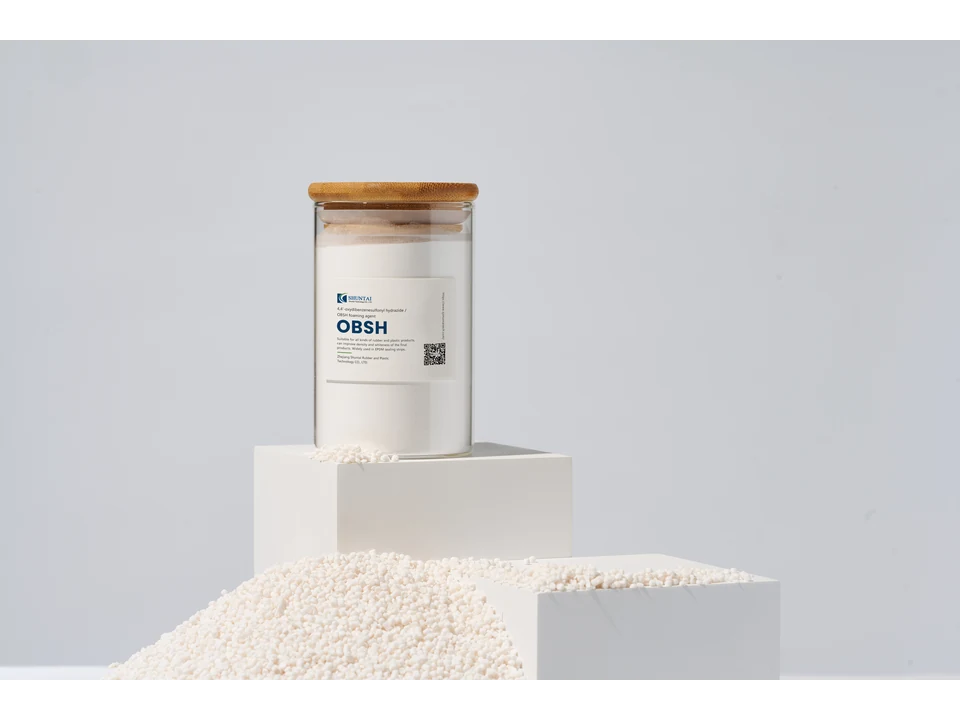
This is an application framework, not a documented customer success case. Product photographs below show material candidates, not installed customer parts.
The service source describes insufficient expansion, coarse or merged cells, collapse, shrinkage, yellowing, odour and batch variation. These symptoms can involve the blowing agent, cure system, actual material temperature, dispersion, pressure and cooling together.
Account for shear heating, mixing, the cure system and product thickness. Document which formulation and equipment settings may be changed and which must remain fixed. Evaluate gas release alongside the compound’s ability to retain gas and stabilise cells.
Do not optimise gas yield in isolation. Compare the timing of gas release, compound strength and cure. A fine-cell result on one compound does not establish the same outcome on another grade, production line or cure system.
For each group record model, batch, dose, mixing order, equipment settings, actual material temperature, pressure, speed, residence time, mould/die, cooling and sample time.
| Evaluation | Record |
|---|---|
| Foaming | Apparent density, part weight, expansion and thickness. |
| Cells | Size distribution, open/closed cells, merging, breakage and skin. |
| Dimensions | Appearance, shrinkage and immediate / 24-hour / 7-day / 28-day change, where appropriate. |
| Mechanics | Hardness, rebound, tensile/tear and compression properties required by the customer. |
| Chemical requirements | Odour, VOC, ammonia and formamide are distinct tests; use the specified methods. |
Pending confirmation No customer-specific baseline, trial results or project report has been supplied. This table is a proposed recording framework, not a results claim.
A successful small trial does not establish stable production performance. Recheck batches, actual equipment temperatures, mixing and feeding, speed, pressure, residence time, mould/die condition, cooling and ageing during the production trial.
Technical advice does not replace the customer’s formulation responsibility, production verification, finished-product testing or target-market requirements.
The service document allows a first discussion from the material system, actual processing temperature, existing agent and main issue. Further selection still depends on adequate technical information.
Evaluate cells, dimensions, appearance, mechanics, odour and stability alongside the density target and acceptance criteria.
Tell us the rubber grade, cure system, equipment and fixed limits, current problem and target properties.
Discuss a rubber foaming trialApplication & sourcing support
Share your process or an existing product model. This is a local preview; no message will be sent.