
product · representative review
OBSH Blowing Agent
Start with your rubber compound, cure system and actual processing temperature. Evaluate OBSH against the cell structure and finished-part requirements of your application.
Discuss this requirementSource gaps remain identified. This page is not a grade or performance approval.
A defined grade. A process-specific decision.
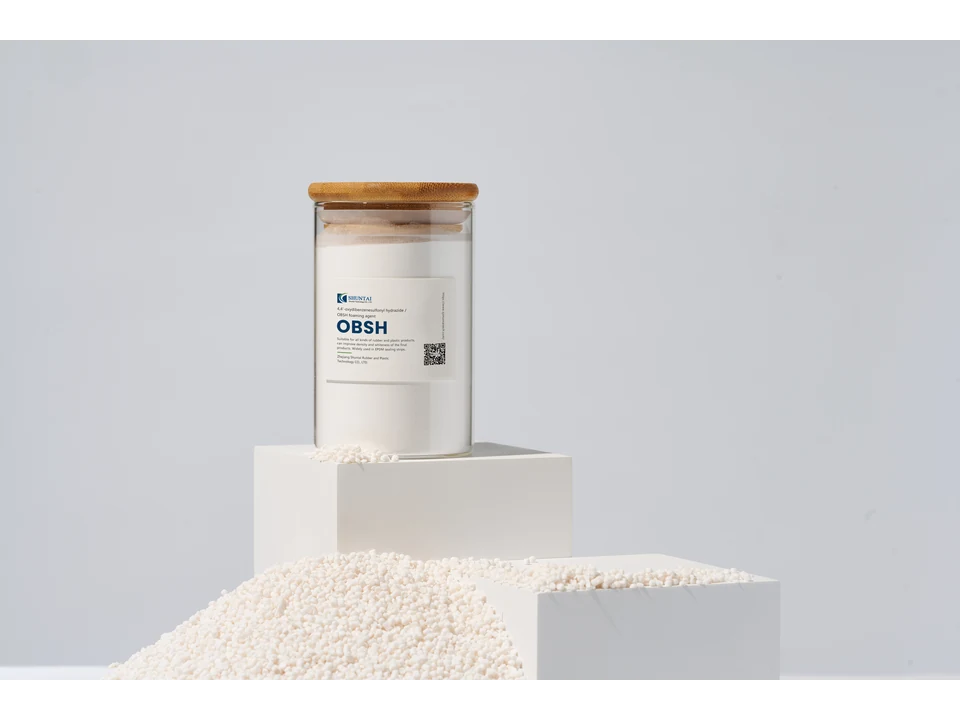
The supplied OBSH manual describes a white hydrazide blowing agent with a relatively low decomposition temperature and fine-cell foaming applications. It identifies rubber foaming as a principal use and also mentions selected polyolefin and adhesive applications.
These application directions are a starting point for evaluation. They do not establish compatibility with every rubber, plastic or adhesive formulation. OBSH and OBSH-1 are separate grades; do not substitute the specification of one for the other.
Begin with the compound and cure window
For rubber foaming, provide the polymer and grade, the current formulation, cure or crosslinking system, actual material temperature, residence time and intended cell structure. The service source covers EPDM, NBR, SBR and other rubber systems; individual suitability remains subject to trials.
Compare density, surface condition, cell structure, dimensions and mechanical properties under controlled conditions. For a polyolefin or adhesive enquiry, confirm the intended function and processing conditions before treating the manual’s application note as a recommendation.
Reference specifications from the supplied manual
The following values are transcribed from the supplied OBSH manual, not a current batch certificate or an approved purchasing specification.
| Property | Manual value | Verification status |
|---|---|---|
| Appearance | White powder | Manual description |
| Decomposition temperature | 150–164 °C | Method and current revision pending |
| Particle size / fineness | 6–10 μm | Particle-size definition pending |
| Gas yield | 118–130 ml/g | Test conditions pending |
| Manual packaging | 25 kg, inner plastic liner with carton or kraft bag | Confirm available packaging for the order |
Pending confirmation Current TDS revision, test methods, batch COA, shelf life and purchasing acceptance limits remain to be confirmed. No cross-grade parameter transfer is permitted.
Boundaries before a production trial
Match gas release to the point at which the compound can retain gas and the cure system can stabilise the cells. Record mixing and dispersion, actual material temperature, pressure, speed, residence time and cooling.
Dosage, activation conditions and cure adjustments are formulation-specific. No universal addition rate, density reduction, mechanical-property guarantee or market-wide compliance claim is assigned to this grade.
Compare a baseline, a replacement and an optimised trial
- Current baseline: keep the existing compound, blowing agent, dosage and process; record the current result.
- Direct replacement: change only the candidate blowing agent to distinguish the grade effect.
- Optimised condition: review temperature, time, line speed, pressure or cooling within the customer’s permitted range.
- Alternative route: compare a second grade or a compound route where the evidence supports it.
Record density, cell distribution, shrinkage, colour, mechanical properties, odour and process stability. The customer’s finished-part specification determines acceptance.
Request the documents for the actual grade
- TDS
- Specification, method and revision for the selected model.
- SDS
- Handling, storage and transport information for the actual product.
- COA
- Results for the supplied batch, separate from general brochure values.
Pending confirmation Current model-specific TDS/SDS/COA and applicable original reports are not attached to this preview. No certificate or download button is fabricated.
Packaging, storage and handling
The supplied manual lists a 25 kg pack with an inner plastic liner, in a carton or kraft paper bag. Confirm the order’s pack format and destination requirements separately.
Its storage note calls for a cool, dry place away from sparks, fire and heat. Use the current grade-specific SDS for safety instructions, emergency measures and transport classification. The manual is not a replacement for that document.
Pending confirmation Shelf life, MOQ, dispatch time, pallet/loading plan and current transport classification require order-specific confirmation.
Questions to settle before sampling
Is OBSH the same as OBSH-1?
No. The supplied OBSH-1 manual describes an adjusted decomposition rate for selected rubber applications. Keep its specifications and trial records separate.
Can you recommend a dosage from the rubber name alone?
The service process requires formulation, cure system, actual temperature, residence time and target properties. Start with a controlled comparison rather than a fixed universal dose.
Tell us what the compound needs to achieve
Share the rubber grade, cure system, current blowing agent, actual temperature, target density or cells, expected quantity and destination.
Request an OBSH discussion